Analyzing the Components and Strategies of Successful Ecosystem Business Models
Traditional military strategy required an understanding of the terrain and a planning for various scenarios that opposing troops would engage in.
Ecosystem strategy development starts out with mapping the terrain as well. Ecosystem mapping involves identifying the different value levers that firms may employ to compete and proactively determining which traditional value levers get commoditized with technology shifts and which future value levers accrue more value.
We are delighted to announce the launch of the Ecosystem Business Model Innovation Playbook, a detailed teardown of business models that firms may pursue with an ecosystem strategy, and an analysis of more than 20 detailed case studies of firms that have successfully employed such strategies.
In an earlier issue of this newsletter, we looked at an overall framework to think about value creation in ecosystems.
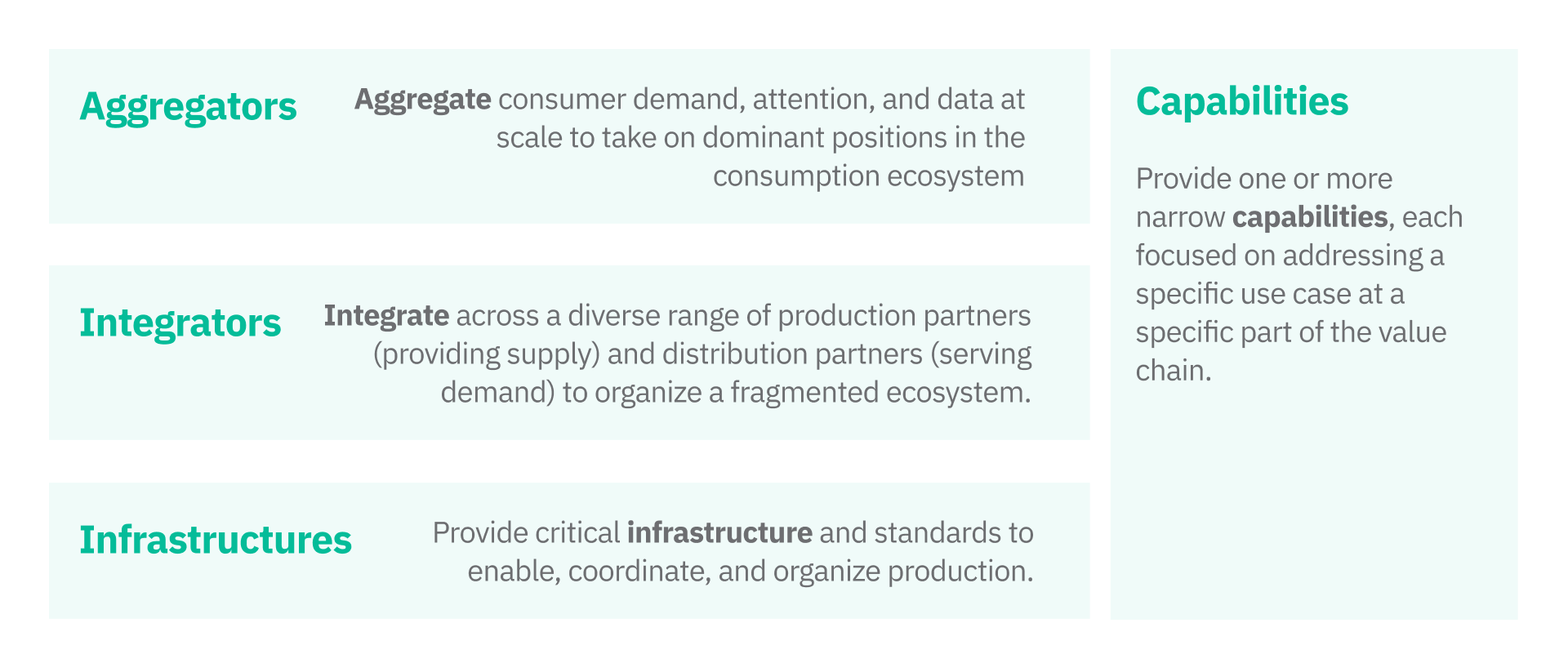
Three horizontal business models emerge which concentrate most of the value in modular ecosystems.
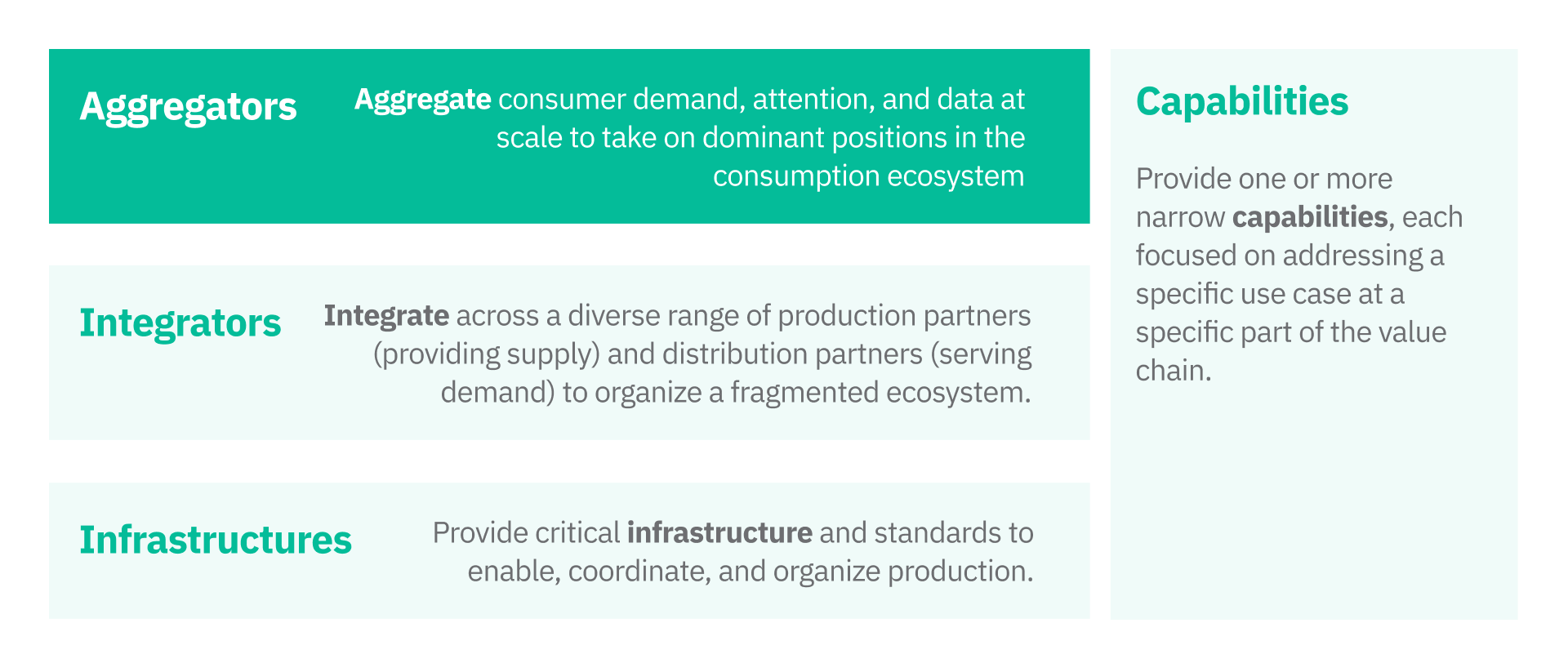
Aggregators aggregate consumer demand by building engagement through consumer-facing services. They leverage this control over consumer engagement (and data) to mediate interactions between consumers and third party producers.
Instagram, TikTok, Amazon Alexa, are all examples of aggregators.
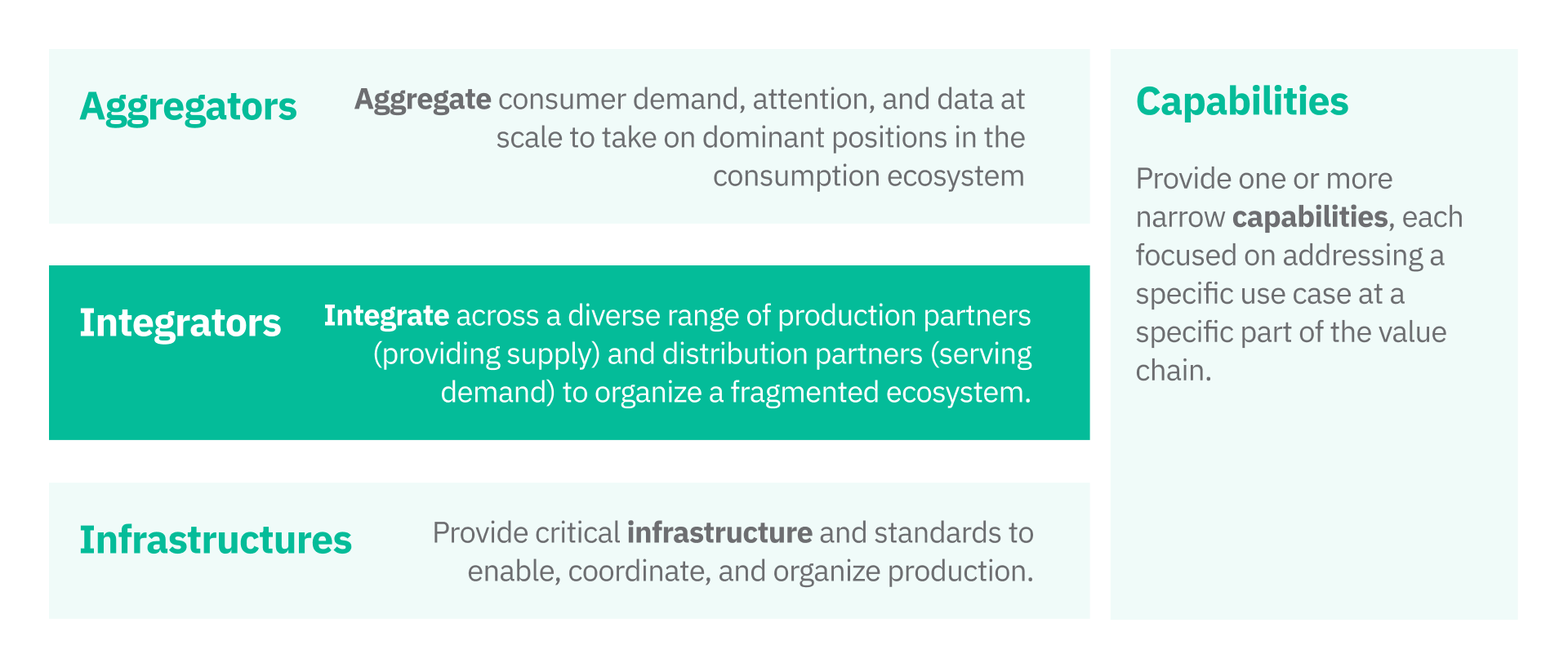
Integrators manage interactions between production and consumption ecosystems through the use of APIs. On the supply/production side, an integrator aggregates product provisioning APIs across the production ecosystem, and on the demand/consumption side, it integrates across distribution environments (websites, apps, and other digital services) in the consumption ecosystem.
Booking.com’s B2B business in online travel distribution, as well as BAAS platforms like SolarisBank, are examples of integrator business models.
Shopify, Unity’s Unreal engine, and Amazon Logistics are all examples of infrastructures serving larger ecosystems.
Additionally, firms must look to externalize capabilities – that they specialize in and can deliver at scale – for ecosystem-wide consumption.
As explained in an earlier essay unpacking Reliance Jio’s strategy:
Economic value is increasingly created not within individual firms but through the interactions among firms across the ecosystem. Understanding value creation at the level of the ecosystem is more important than merely understanding it at the level of a single firm. Competitive advantage, in turn, is no longer determined merely by a firm’s activities but by the layers those activities occupy in the value stack.
In this new landscape, power concentrates with players that dominate a specific layer. The strongest players leverage their dominance at one layer to occupy multiple positions across different layers without requiring traditional vertical integration. Firms can effectively excel at both innovation and efficiency by choosing a combination of such positions.
Reliance Jio demonstrates that incumbents may leverage their deep infrastructural and regulatory moats and partner with BigTechs to dominate the ecosystem together. It also demonstrates the sobering reality that such large ecosystem plays require a bold vision, an appetite for high-risk investment, and the execution chops to scale and dominate rapidly
Rethinking growth and go-to-market in the age of AI Rapid improvements in AI create new…
How to create new industries ground-up Why is SpaceX more agile and successful than NASA…
The subtle lies of bundling convenience with extraction Today’s platform economy - mediated by the likes of…
How AI Agents and Open APIs create new rebundling opportunities Much of the AI hype…
Gaining power in concentrated markets What do Spotify, the connected vehicle data market, open banking…
The unbundling and rebundling of organizations We frequently make the mistake of thinking of AI…