

Ecosystem Innovation Playbook
Strategize for the ecosystem, map out your value stack, identify future business models and control points, and map out an ecosystem design roadmap to win in this emerging landscape.
CO-AUTHORED BY:



Ecosystem Design - Key Highlights
The shift from vertically integrated industry structures to modular ecosystems creates unprecedented opportunities for business model innovation.
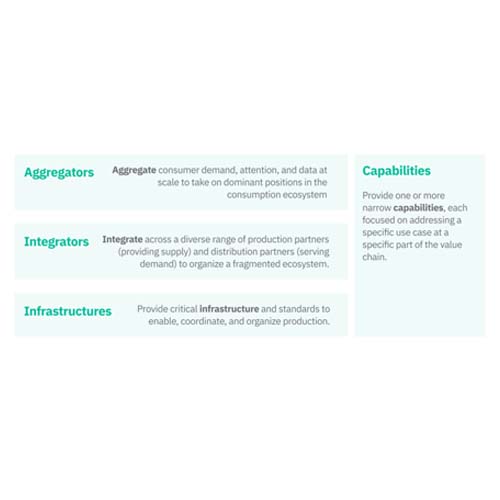
Four key business models emerge in modular ecosystems: aggregators, integrators, infrastructures, and capabilities.
To strategize for the ecosystem, firms must map out their overall ecosystem value stack and identify key positions and business models that grant them competitive advantage.
Incumbents strategies will need to span both offensive and defensive moves to proactively defend current positions of value and take up new value stack positions.
Key Insights of Ecosystem Design & Innovation
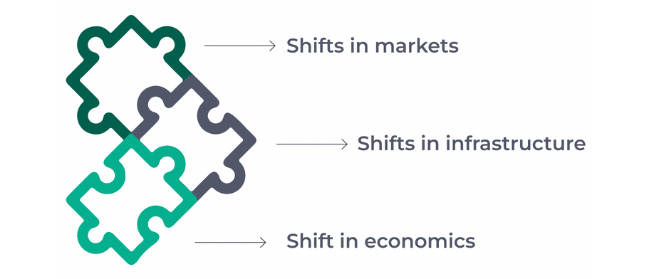
We note three key shifts in the competitive landscape:
(1) Shift from serving customers to empowering ecosystem stakeholders.
(2) Shift from competing on resource ownership (supply-side) to competing on ecosystem participation (demand-side).
(3) Shift from managing internal processes to orchestrating ecosystem interactions.
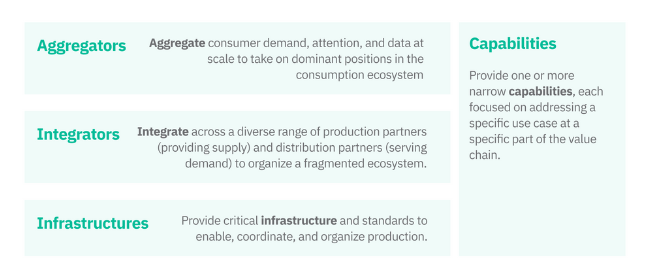
Ecosystem innovation requires strategizing across a modular value stack to identify future business model positions.
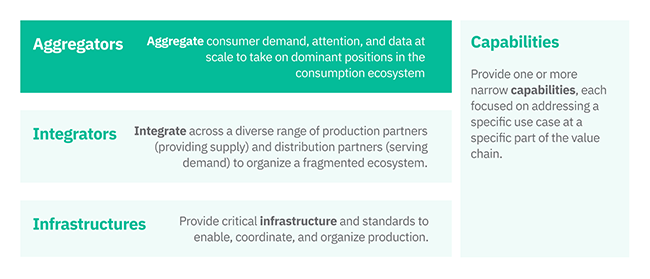
Aggregators aggregate consumer demand by building engagement through consumer-facing services. They leverage this control over consumer engagement (and data) to mediate interactions between consumers and third party producers. Aggregators typically benefit from low marginal costs of serving consumers which allows them to build consumer engagement at scale. As ownership of consumer engagement becomes more scarce in a digital world, aggregators act as gatekeepers of market access for producers looking to interact with consumers.
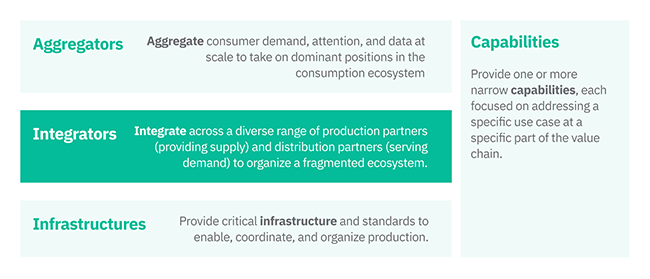
Integrators manage interactions between production and consumption ecosystems through the use of APIs. On the supply/production side, an integrator aggregates product provisioning APIs across the production ecosystem, and on the demand/consumption side, it integrates across distribution environments (websites, apps, and other digital services) in the consumption ecosystem. Integrators provide an opportunity to bundle multiple services from the production ecosystem and drive efficiencies by acting as a one-stop’ distribution point’ across an increasingly modular and diverse ecosystem.
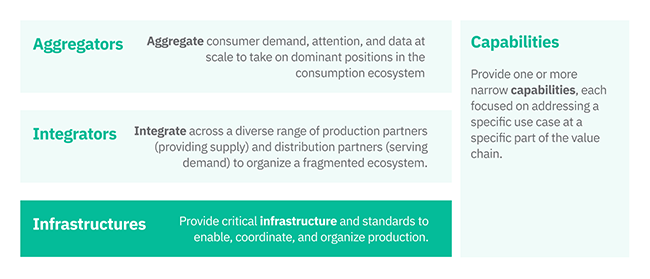
Infrastructures provide core production infrastructure, standards, information services, and data assets to inform, coordinate, and support production activities that firms engage in. Infrastructures coordinate the activities of ecosystem firms across a core production process, towards a common production output.
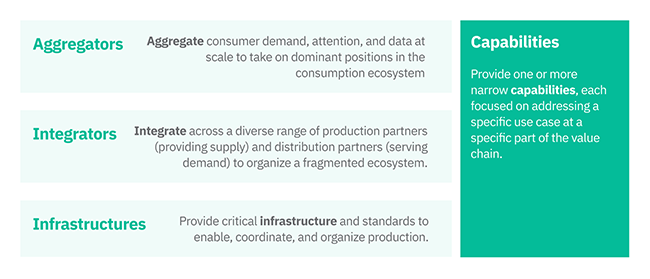
Capabilities are business capabilities, focused on the performance of specific functions, that may be licensed to third party ecosystem actors, and may be embedded into aggregators, integrators, and/or infrastructures. For instance, a financial services aggregator may leverage an external identity management capability while a healthcare infrastructure may leverage a healthcare diagnostic AI capability.
To strategize across the stack, firms must follow a four-step approach to ecosystem design:
-
- Determine current positions across the value stack where they continue to play and current positions they abandon because of impending commoditization.
- Select future positions that provide competitive advantage which they wish to migrate to, and map out build-partner-buy options to aid that migration.
- With this portfolio of future positions across the stack, identify factors that reinforce value and defensibility across these future positions by developing business models that integrate multiple positions.
- Develop a reliable, self-learning mechanism to continuously monitor competitor moves, particularly moves by non-traditional competitors moving in adjacent stack positions.
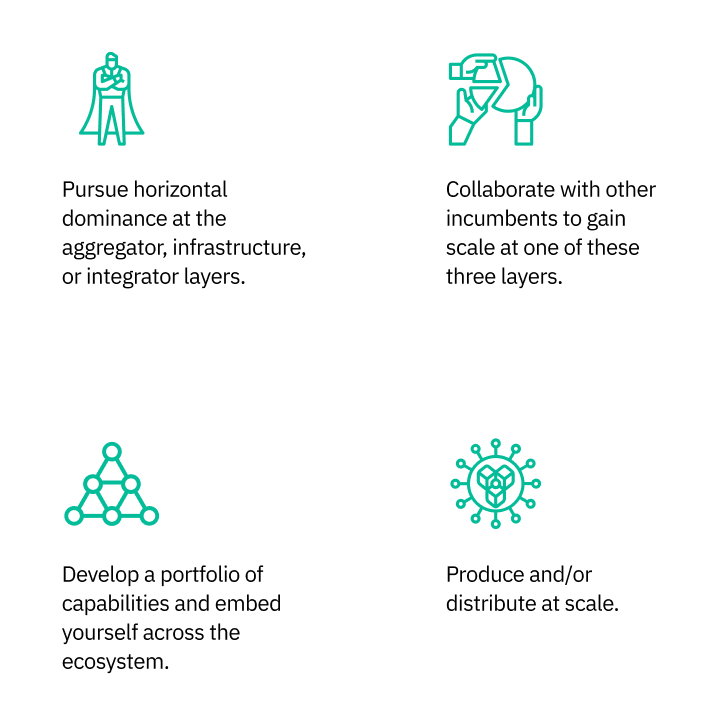
Firms may work across a spectrum of four choices while participating in modular ecosystems.
- Pursue horizontal dominance at the aggregator, infrastructure, or integrator layers.
- Collaborate with other incumbents to gain scale at one of these three layers.
- Develop a portfolio of capabilities and embed yourself across the ecosystem.
- Produce and/or distribute at scale.
Map your
digital ecosystem strategy

- Leverage our extensive library of ecosystem maps created across different industries
- Determine potential value pools and business models in your industry
- Design and strategize for platform business models within the defined industry ecosystem
- Identify ecosystem control points to gain competitive advantage
Engage Our Advisory

Ecosystem Design and Platform Strategy
Our most popular engagement model, offering multi-week remote and in-person expert advisory services to outline and design a platform business model and strategy
Learn More
Ecosystem Execution and Innovation
In partnership with a global consulting firm, we work with clients to drive their execution through a tried and tested platform execution process model.
Learn More
Ecosystem Education and Evangelism
Executive leadership learning programs and corporate-wide training program, based on the research behind international best-selling books, Platform Revolution and Platform Scale
Learn More

Download Our Advisory Kit
To discover how we can transform your platform business