Web2 platforms like Kickstarter, Udemy, and Skillshare scaled by getting power producers onto the platform early on. These producers, in turn, onboarded their followers as consumers, some of whom, then further converted into producers and a cycle of user acquisition and ever-increasing network effects started building up.
Owing to tokenised ownership, Web3 platforms can turbocharge power user strategies. As centralized ownership of the platform decreases, power users play an increasingly important role by driving growth of the platform and reaping the ensuing gains.
This essay provides a teardown in one of the most important Web3 strategies: Leveraging power users.
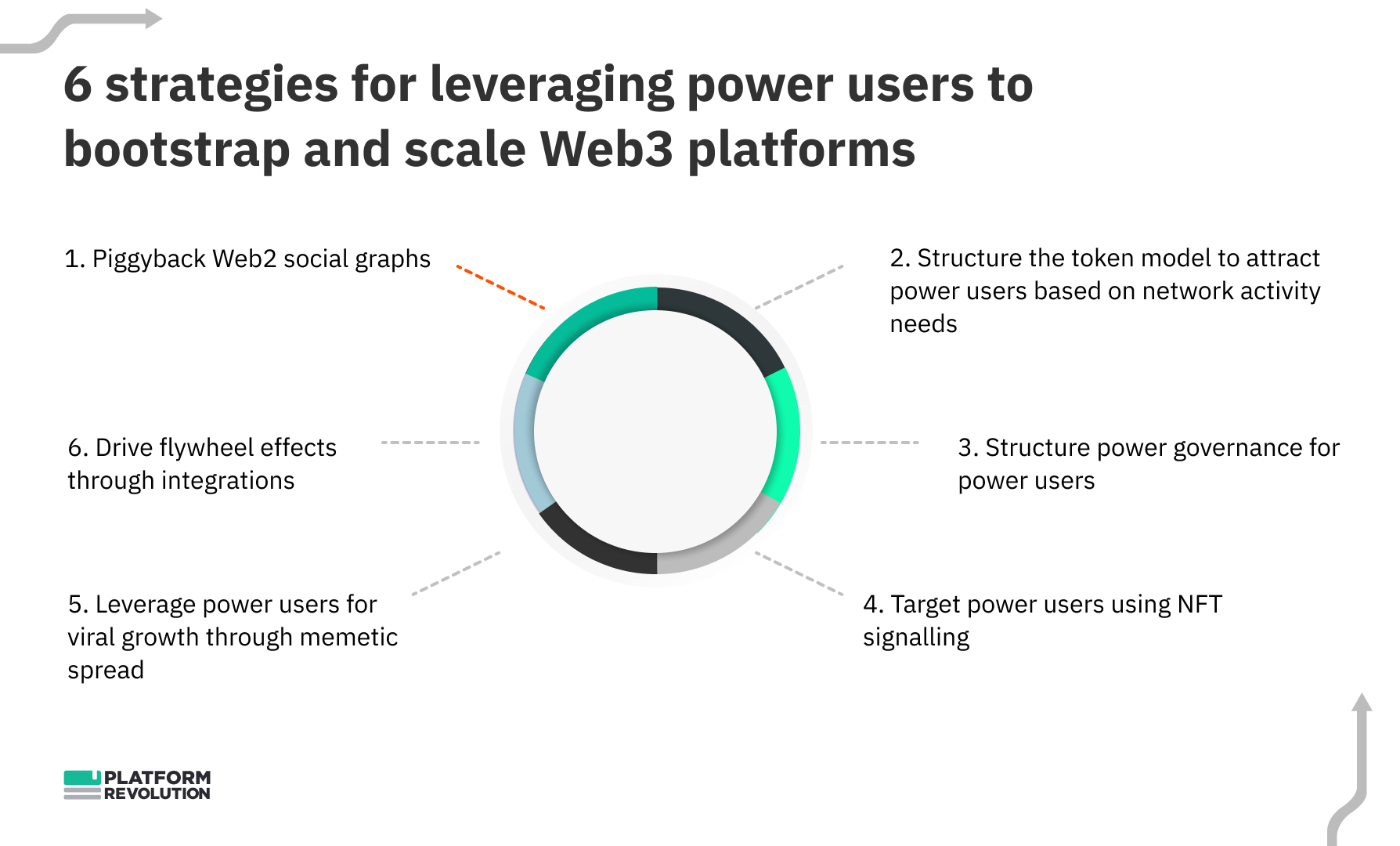
Specifically, this essay explores 6 strategies for leveraging power users to bootstrap and scale Web3 platforms.
This article is part of the upcoming Web3 Bootstrapping Playbook. Sign up here to get early access to the playbook when it launches:
Power users play a key role in the creation of network effects. Not all nodes on a network are equal, some – power users – contribute much higher activity to the network than others.
Power users may be power producers or power consumers or both. Power producers bring higher supply to the platform. Power consumers are responsible for driving demand. Power users drive outsized activity on the platform. Early on, getting power users onto the platform helps overcome the chicken and egg problem that most platforms face.
On Web2 platforms, power users primarily derive transactional benefits. For instance, a project creator on Kickstarter would promote their project to their social media following and mailing lists to benefit from crowdfunding. Online education marketplaces like Skillshare started by onboarding star educators like Seth Godin who would then promote their course to an established following they had already built outside the platform.
In both these examples, the transactional benefits of the platform (get your project funded on Kickstarter, sell your course on Skillshare) were the primary reasons why producers brought their following onboard the platform. In some cases (e.g. Skillshare), the platform didn’t charge transaction fees on transactions where the producer had onboarded off-platform followers. However, benefits for power producers on Web2 platforms were limited to such transactional benefits.
Web3 platforms unlock three additional value levers for power users (particularly producers) to benefit from bringing their following on board. Through fungible and non-fungible tokens, power producers gain greater returns on their actions in helping grow an underlying platform.
Effectively, through additional ownership benefits – both in terms of platform ownership and content ownership – power users are incentivised to keep promoting not just their own content (as they already did in Web2) but also the underlying platform and any derivative content that is created on the platform.
Rethinking growth and go-to-market in the age of AI Rapid improvements in AI create new…
How to create new industries ground-up Why is SpaceX more agile and successful than NASA…
The subtle lies of bundling convenience with extraction Today’s platform economy - mediated by the likes of…
How AI Agents and Open APIs create new rebundling opportunities Much of the AI hype…
Gaining power in concentrated markets What do Spotify, the connected vehicle data market, open banking…
The unbundling and rebundling of organizations We frequently make the mistake of thinking of AI…