The early promise of Web2 was built around the argument of the long tail.
Back in 2006 – the early days of Web2, when Facebook was still a dorm room phenomenon and Yahoo was making fun acquisitions in user-generated content – Chris Anderson published his NYTimes bestseller “The Long Tail”, arguing that the internet would empower niches in the long tail. And that, by extension, business value would shift away from a few ‘fat/short head’ categories and migrate to many niches across the long tail.
That future didn’t really play out as expected.
Instead, over the next 15 years, we’ve seen large platforms aggregate niche market activity and increasingly centralize value away from these niches.
But with the rise of blockchain-based protocols, we may finally have the necessary business architecture and economic incentives to drive value in niche market activity.
In the coming years, we’ll finally see the ‘revenge of the long tail’.
This essay looks at:
Chris Anderson and other early Web2 pundits who heralded the rise of the long tail got half the argument right.
They figured that ‘shelf space’ was no longer scarce on the internet and, hence, was no longer a bottleneck. The internet allowed unlimited hosting of supply and hence could enable markets around the long tail of products.
What they failed to realize was that the internet, instead, shifts scarcity to the demand side and creates a bottleneck on the demand side. Consumer data and attention are scarce. And as I lay out through a lot of my work, the few firms – aggregators – who could aggregate and centralize consumer data aggregated all market activity.
As I elaborate in The Building Blocks Thesis, this aggregation ran counter to niche market activity:
The challenges posed by centralized platforms emerge because of:
(1) loss of context through standardization and ‘central planning’ and
(2) concentration of power through centralization.
Standardization across diverse contexts involves a trade-off; the loss of end-user context… which effectively kills runs counter to any community effects and cultural effects that niche markets benefit from.
Platforms also leverage their scale and consequent market power to increasingly commodify and disempower platform users.
This disempowerment enables platforms to increasingly extract value from the ecosystem – and particularly away from niche producers.
Finally, the factors above work together to drive concentration of an inordinate amount of wealth in the hands of a few.
General purpose Web2 marketplaces scaled through network effects by controlling both supply-side inventory and demand-side user data.
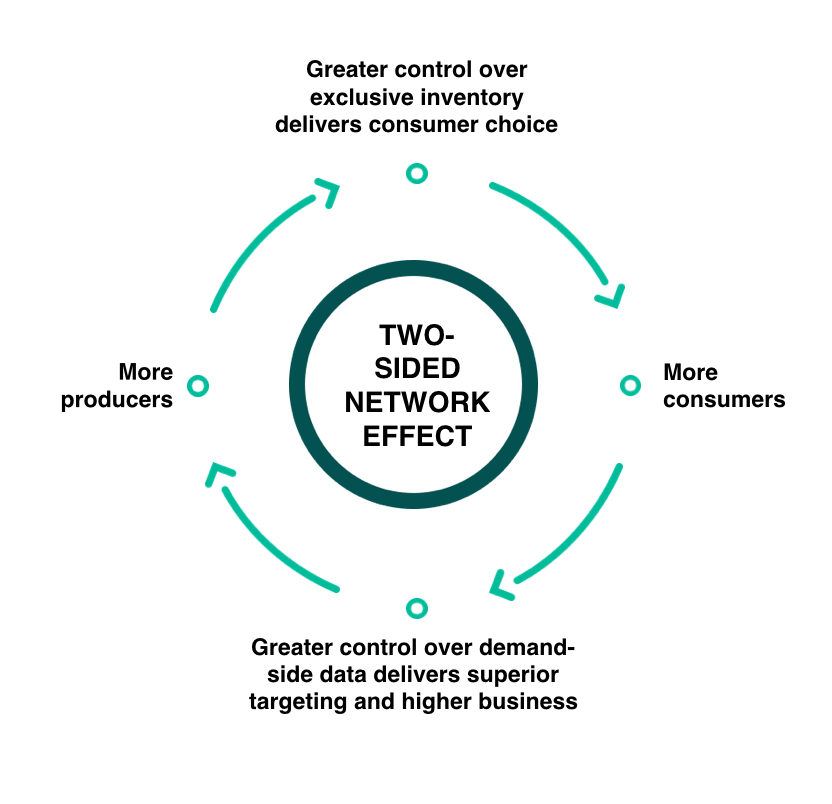
Control over supply side inventory ensured that producers stayed on the platform. Control over demand side data ensured that consumers stayed on the platform. Both sides, then, contributed to the two-sided network effect.
As more producers participated on the platform, more consumers found value and as more consumers participated on the platform, more producers were incentivized to stay one.
This classic two-sided network effect helped scale up platforms and marketplaces.
As these platforms scaled, value created in niches increasingly accrued back to the platform.
This played out in two different ways.
First, successful niches become increasingly organically dependent on the underlying platform. If a producer succeeded in dominating a particular niche, they did so by optimizing their listing for discoverability by the platform’s algorithms. Further, as their visibility and transactions increased, they gained greater reputation and hence greater visibility (think of a five star rated listing ranking higher in subsequent transactions as the platform’s algorithms favoured the listing). This self-reinforcing feedback loop ensured that the niche producer remained successful within the framework of the platform and continue to pay increasing ‘marketplace tax’ as all transactions were funneled through the platform.
Second, platforms exert inorganic control over niches. In some cases, the platform owner may acquire a brand that succeeds in a particular niche. Worse still, in other cases, the platform owner may directly start competing in a niche after its success has been proven out by independent producers. The platform then deprioritizes listings from the niche producers and ends up dominating that niche. Amazon has infamously moved many niche brands off its platform, subsequently entering and dominating those niches through its own products. Platforms may further disempower niche producers by penalizing them for participating on other channels. Amazon’s price matching algorithm is one such example.
Owing to the above factors, it becomes increasingly difficult for long tail producers to organize themselves in niche markets, driving more such activity to horizontal platforms.
With the rise of protocol-based market coordination, niche markets are poised to make a comeback.
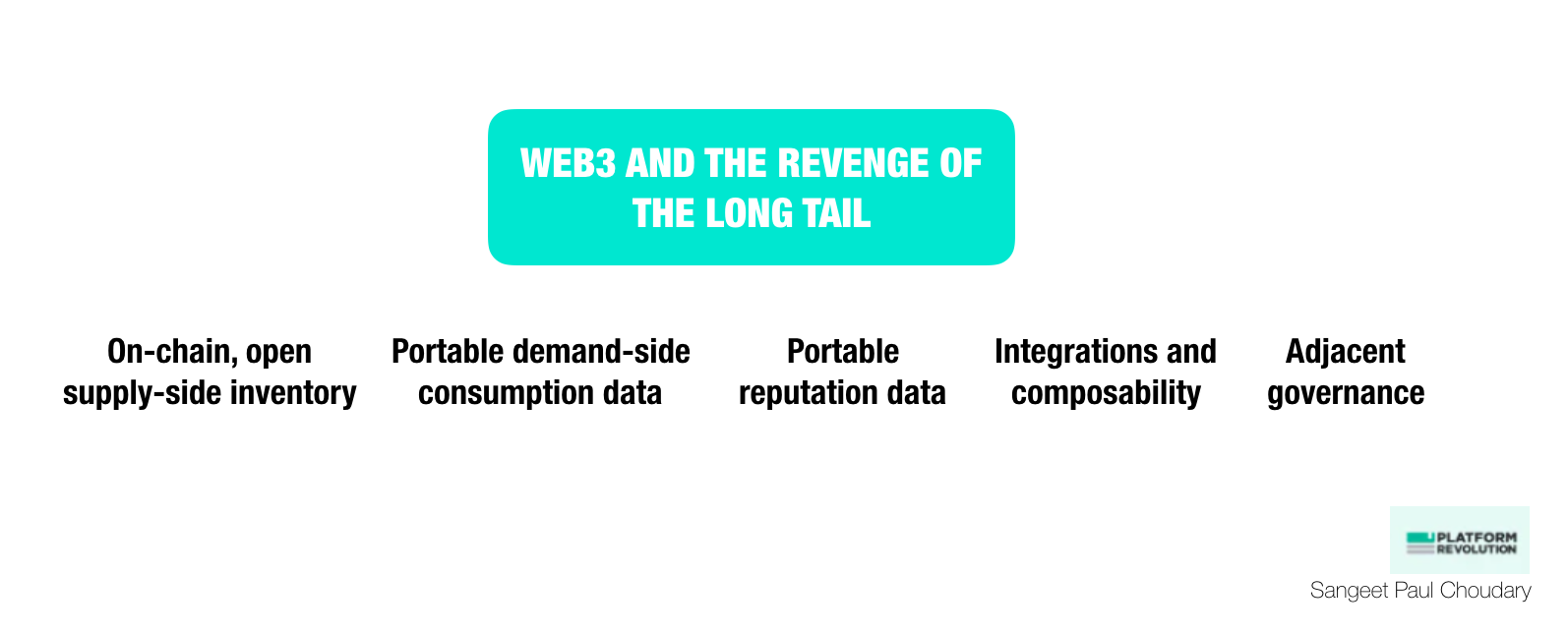
There are five specific reasons why Web3 enables niche market activity.
On the supply side, inventory is no longer ‘locked in’ to specific platforms. Supply side inventory is on-chain and openly accessible. Once onboarded, all search agents can access the same on-chain inventory. Control over supply – a hallmark of web2 – is no longer a source of lock-in in Web3.
Equally importantly, demand-side consumption data is portable across platforms. Web2 platforms relied on news feeds and recommendation systems to constantly engage users. Consumption data – extracted and controlled by the platform – enabled superior recommendations and personalized feeds, locking the user into the platform. With data portability, users can move their data across search agents and continue to benefit from highly personalized recommendations.
This removes user-side lock-in, again, one of the key control points for Web2 platforms.
Reputation data portability removes lock-in as both producers and consumers can port their reputation data into competing providers.
Integrations and composability are additional drivers enabling the rise of niche markets in Web3. Niche markets may gain from activity across a wide range of ecosystems by being integrated across them. For instance, a niche market for trading a specific type of in-game collectible may gain adoption through integrations with many different Web3 gaming worlds.
Finally, niches can also coordinate activity through adjacent governance. A niche Web3 market maker may purchase governance tokens in another niche if there is substantial overlap in user base. This allows the two niche markets to coordinate their evolution and roadmap while serving similar user bases.
As I shared in Unbundling the unbundlers,
The market governance embedded at the protocol layer enables market infrastructure components to be unbundled to their most basic units.
For instance, a marketplace like Ebay bundles seller onboarding, seller analytics, buyer onboarding, buyer decision support, search functionalities, and exchange infrastructure. All these components will be unbundled in a Web3 world.
As a result, we move away from central market-maker architectures to decentralized agent-based architectures, all coordinated by a shared, common protocol.
These agent-based architectures enable the creation of niche marketplaces with niche-specific user journeys, all supported by a common protocol.
While Web2 marketplaces like Ebay scale horizontally across niches, it is increasingly likely that horizontal Web3 marketplaces like OpenSea will be confronted with growing competition from stand-alone NFT storefronts.
Rethinking growth and go-to-market in the age of AI Rapid improvements in AI create new…
How to create new industries ground-up Why is SpaceX more agile and successful than NASA…
The subtle lies of bundling convenience with extraction Today’s platform economy - mediated by the likes of…
How AI Agents and Open APIs create new rebundling opportunities Much of the AI hype…
Gaining power in concentrated markets What do Spotify, the connected vehicle data market, open banking…
The unbundling and rebundling of organizations We frequently make the mistake of thinking of AI…