


Concepts
The Platform Manifesto
One of the key themes I explore in my work is the shift from pipes to platforms. I’ve written an entire book dedicated to this theme, Platform Scale, and through this post, I’d like to lay out a set of concepts that are explained in Chapter 1.2 of the book as The Platform Manifesto.
The Platform Manifesto is a collection of principles that succinctly defines how different aspects of business transform in a world of platforms. The deck below is a comprehensive overview of the contrast between pipe scale and platform scale: the way in which businesses scaled in the world of pipes vs. the way in which businesses scale in a world of platforms.
The key principles of the platform manifesto are as follows:
- The ecosystem is the new warehouse
- The ecosystem is also the new supply chain
- The network effect is the new driver for scale
- Data is the new dollar
- Community management is the new human resource management
- Liquidity management is the new inventory control
- Curation and repetition are the new quality control
- User journeys are the new sales funnels
- Distribution is the new destination
- Behavior design is the new loyalty program
- Data science is the new business process optimization
- Social feedback is the new sales commission
- Algorithms are the new decision makers
- Real-time customization is the new market research
- Plug-and-play is the new business development
- The invisible hand is the new iron fist
The deck above explains and illustrates these ideas in great detail.
If you haven’t seen my work on pipes vs. platforms before, I’ve included key ideas below the deck. If you’re well acquainted with the idea, please feel free to dive directly into the deck above.
We are in the midst of transformative shift in business design as business models move from pipes to platforms.
Feel Free to Share
Download
Download Our Insights Pack!
- Get more insights into how companies apply platform strategies
- Get early access to implementation criteria
- Get the latest on macro trends and practical frameworks
More on pipes vs. platforms
As I explain in my book Platform Scale, an unconnected world encouraged the flow of value predominantly through pipes:
“Pipes have long served as the dominant business design for the industrial economy. Firms build products or craft services, push them out, and sell them to customers. Value is produced upstream and consumed downstream, creating a linear flow of value, much like water flowing through a pipe. In effect, pipes were designed to enable the flow of value in a straight line.
Pipes appear in nearly every area of modern industry. The traditional manufacturing supply chain runs on a pipe model. Every consumer good that finds its way into our hands comes down a pipe that constantly adds value to the product. Our service organizations work like pipes; they aggregate the resources for service provision and deliver those services to clients. Traditional media – television, radio, and newspapers – are pipes pushing content to us. Our education system often works like a pipe where teachers push “knowledge” to receptive students. There is a linear movement of value from a producer to one or many consumers in all examples of pipe businesses.”
This is in contrast with the platform model of business design that we increasingly see gaining traction around us over the last few years.
“We are in the midst of transformative shift in business design as business models move from pipes to platforms.
Three forces today – increasing connectedness, decentralized production, and the rise of artificial intelligence – are driving a whole new design for business.
The emerging design of business is that of a platform. Some of the fastest-scaling businesses of the last decade – Google, Facebook, Apple, Uber, and Airbnb – leverage the platform business model. These businesses create a plug-and-play infrastructure that enables producers and consumers of value to connect and interact with each other in a manner that wasn’t possible in the past. Facebook provides an infrastructure for users to connect with each other and enables interactions between them. Uber coordinates drivers and passengers toward economic exchanges. Many businesses today act as platforms enabling interactions among their participants.
Platforms allow participants to co-create and exchange value with each other. External developers can extend platform functionality using its APIs and contribute back to the very infrastructure of the business. Platform users who act as producers can create value on the platform for other users to consume.
This changes the very design of the business model. While pipes created and pushed value out to consumers, platforms allow external producers and consumers to exchange value with each other.”
State of the Platform Revolution
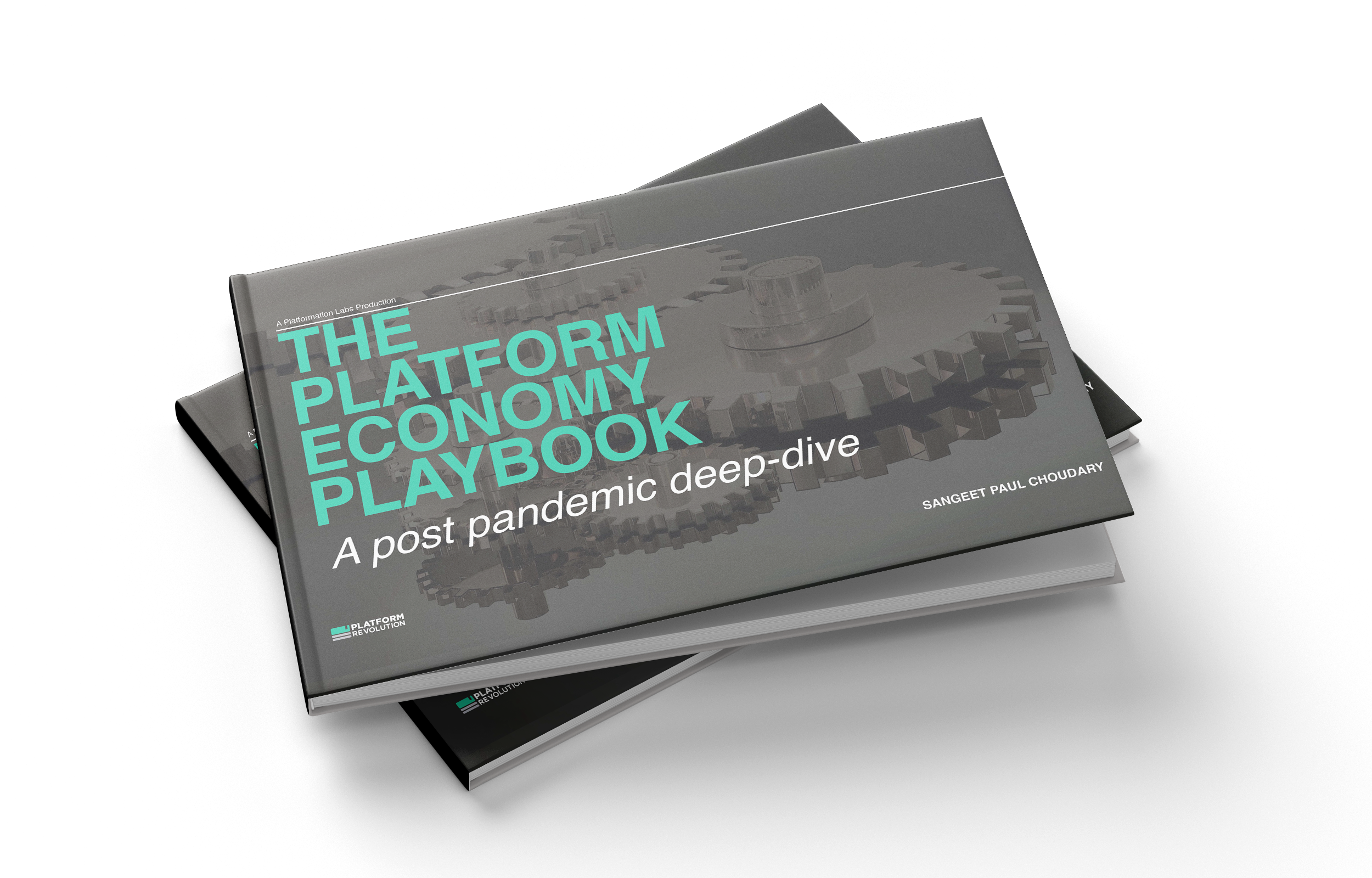
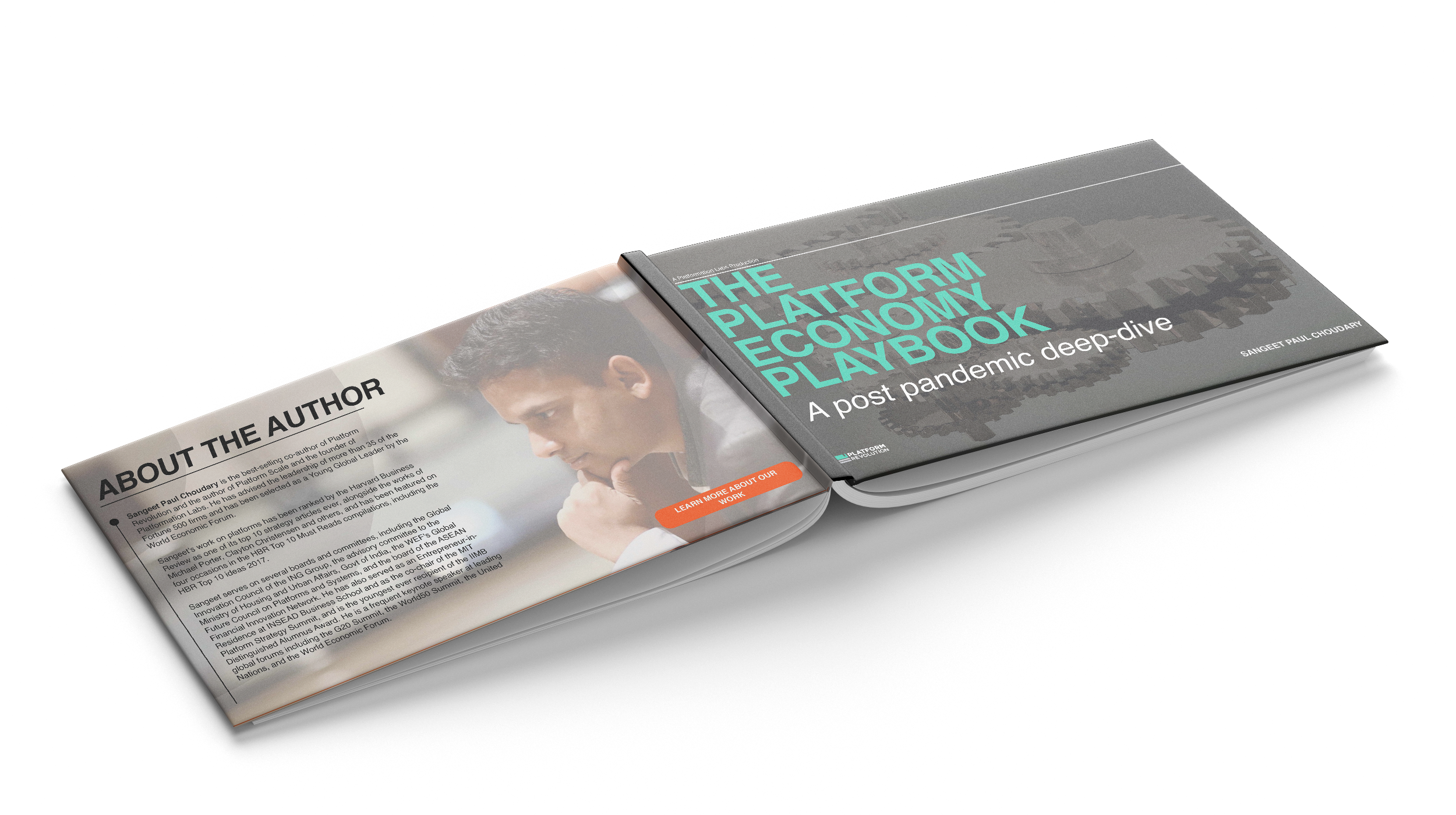
The State of the Platform Revolution report covers the key themes in the platform economy in the aftermath of the Covid-19 pandemic.
This annual report, based on Sangeet’s international best-selling book Platform Revolution, highlights the key themes shaping the future of value creation and power structures in the platform economy.
Themes covered in this report have been presented at multiple Fortune 500 board meetings, C-level conclaves, international summits, and policy roundtables.
Subscribe to Our Newsletter
