

The false bundles of the platform economy
The subtle lies of bundling convenience with extraction
Today’s platform economy – mediated by the likes of Amazon, Google, Uber, and others – started out with the promise of making markets more efficient and empowering end users by removing inefficient intermediaries.
Ironically, it’s succeeded in doing quite the opposite.
Markets mediated by these platforms become more inefficient over time and users (both producers and consumers) become increasingly disempowered.
How did we end up here?
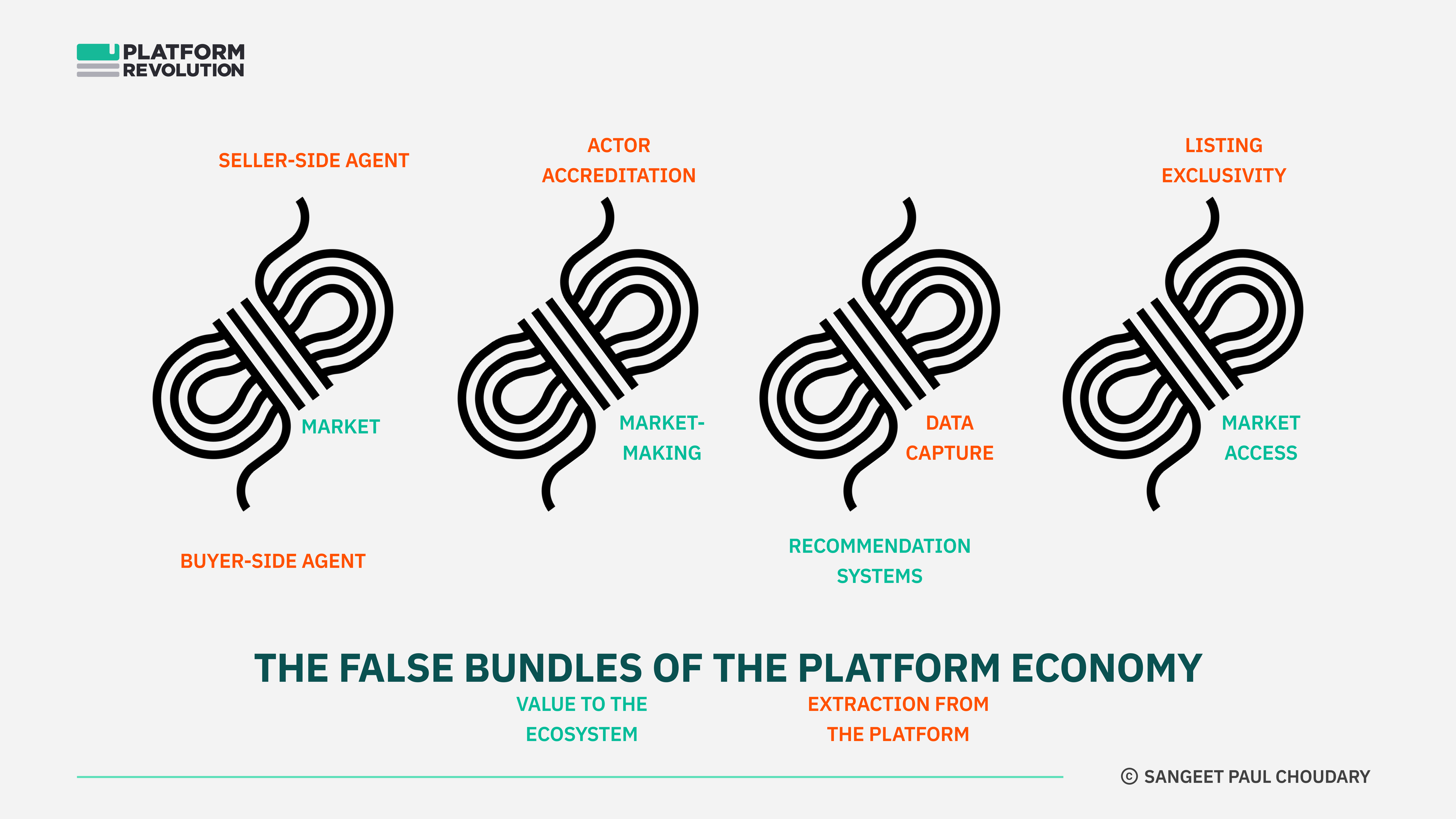
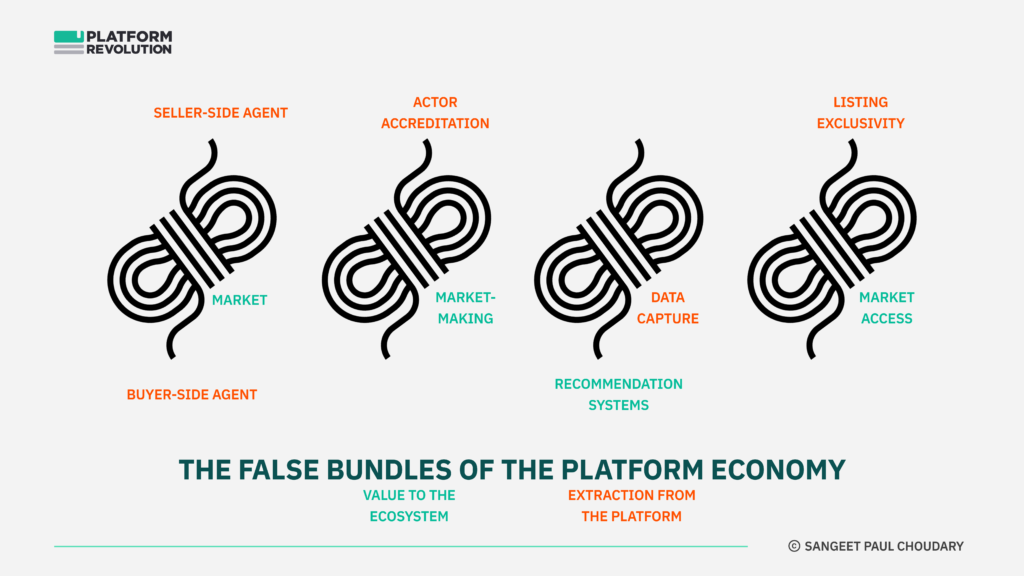
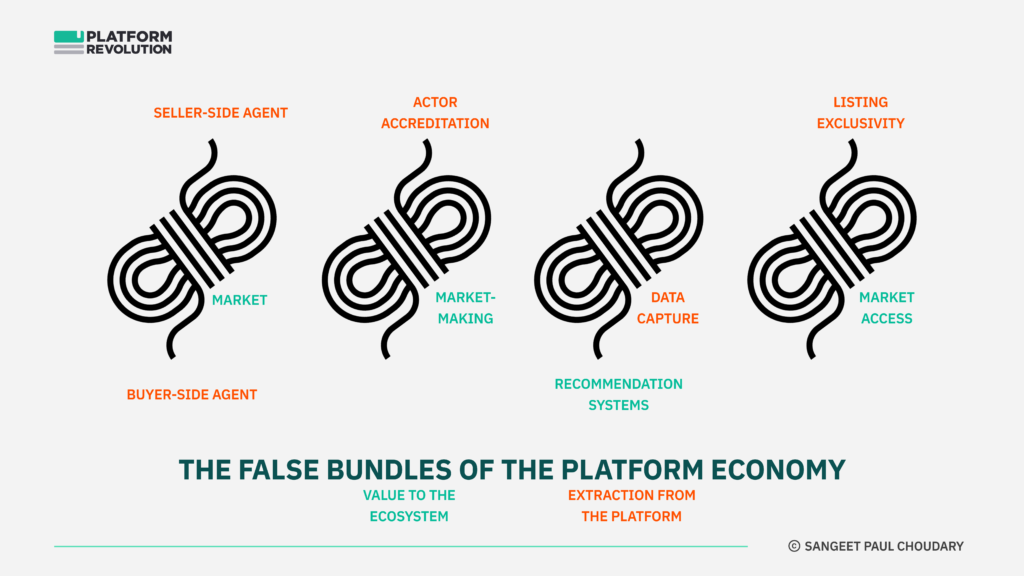
The answer lies in four false bundles that have been legitimised by the platform economy.
- False bundle #1: Bundling markets with agents
- False bundle #2: Bundling actor accreditation with market-making
- False bundle #3: Bundling data capture with recommendation systems
- False bundle #4: Bundling listing exclusivity with market access
But what exactly are false bundles and how have they helped platforms renege on the very promise they started out with.
Let’s dig in!
False bundles in the platform economy
What exactly is a false bundle?
A false bundle combines two seemingly beneficial capabilities/activities into a bundle that becomes a tool for power and profit extraction.
Individually, each of these capabilities may fulfil a relevant role in facilitating market activity.
But bundling them into one entity creates a conflict of interest with the ecosystem and creates a tool of power and wealth extraction in favour of the platform.
Consider the third bundle listed above: Bundling data capture with recommendation systems.
Platforms bundle the right to capture data with the convenience of personalization. Technically, you could achieve the latter without the former through a user-owned data architecture.
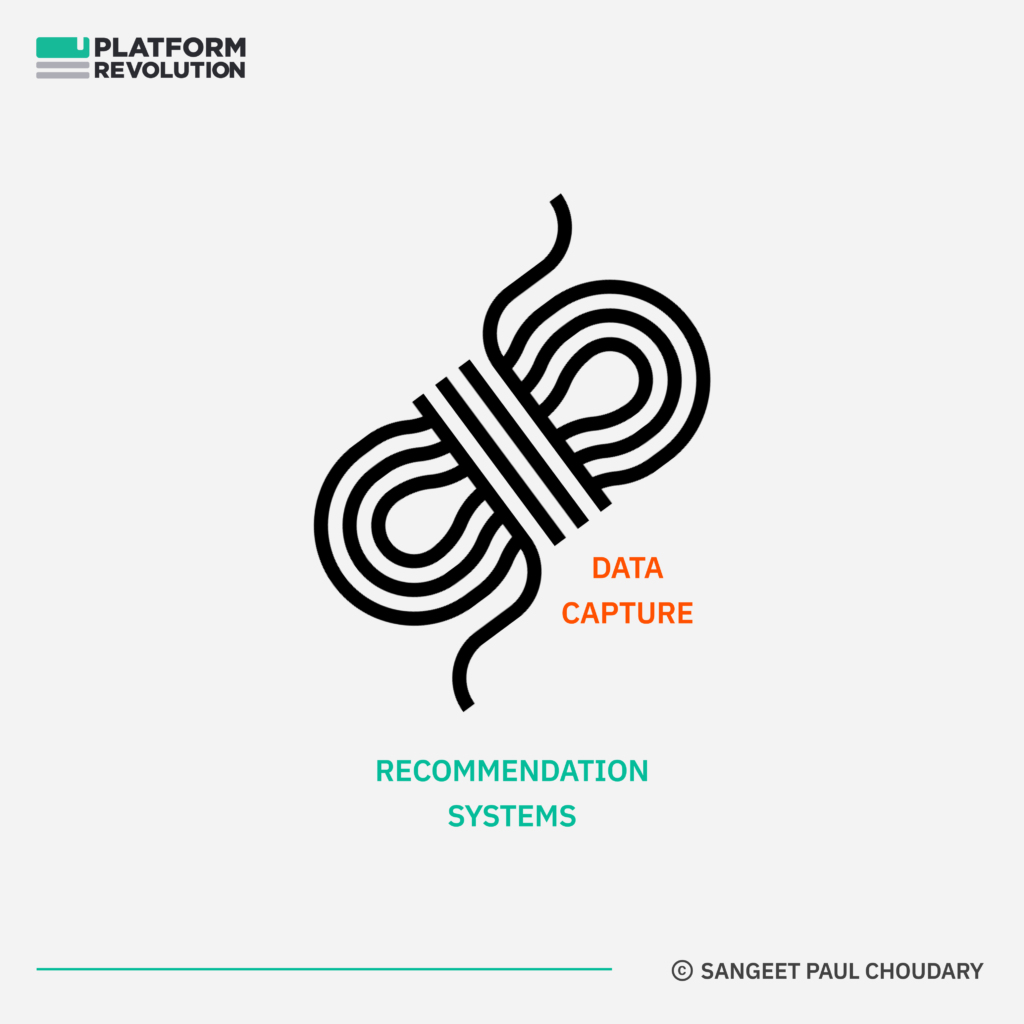
Yet, platforms bundle the two. Only one of these two (personalization) is beneficial for the user. The other is largely a mechanism for wealth and power extraction by the platform.
A false bundle combines these conflicting services, under the guise of market efficiency and/or ecosystem (producers/consumers) benefits, while, in fact, doing quite the opposite.
Most false bundles compromise market efficiency and/or ecosystem benefits (or both). But all false bundles make it easier for the platform to extract more from its ecosystem.
False bundles are created for one and only one purpose – to concentrate power and extract profits for the platform.
Typically, one component of the false bundle creates value for platform users. The other component is bundled in as a necessary trade-off in order to get the first benefit.
But as I explain below, none of these bundles are necessary. The technology for them to be unbundled already exist. They have been bundled purely through deliberate design choices by the platforms.
Let’s look at each of these in turn.
False bundle #1: Bundling markets with agents
Here’s the first false bundle.
Online marketplaces aren’t just markets, they are bundles of markets and agents.
To understand this, let’s look at the difference between agents and markets.
Agents vs markets
A market is a mechanism that facilitates transactions and price determination based on supply and demand dynamics. An agent is a player that acts on behalf of either the producer or the consumer to represent their interests and choices in the market.
A market serves as a broader framework and agents operate within this framework to represent the interests of producers or consumers.
This is a fairly straightforward distinction.
Producers and consumers interact in one of two ways:
1. Directly (e.g. when you buy services from your plumber)
2. Through intermediaries or agents (e.g. when you buy a house)
#1 is great – fewer intermediaries enable better economics.
But #2 – interacting through agents – offers the benefits of aggregation and/or standardization. If you trust agents (and especially where they are accredited) you would rather work through them than directly with an unknown counterparty.
Consider the real estate market. A buyer’s agent may help a homebuyer navigate available choices and negotiate offers with sellers, while a seller’s agent may assist a homeowner in marketing their property and negotiating offers.
Agents and markets play distinct roles. Buyers and sellers often don’t like working through agents and intermediaries when they feel they’re not acting in their best favour.
Platforms would like you to believe that they are removing the agent while imputing trust in direct interactions (e.g. through a rating system).
In this way, they’re providing you the advantages of direct interactions while also providing the advantages of intermediaries.
However, this isn’t exactly right.
Instead of removing agents, platforms ironically do the very opposite.
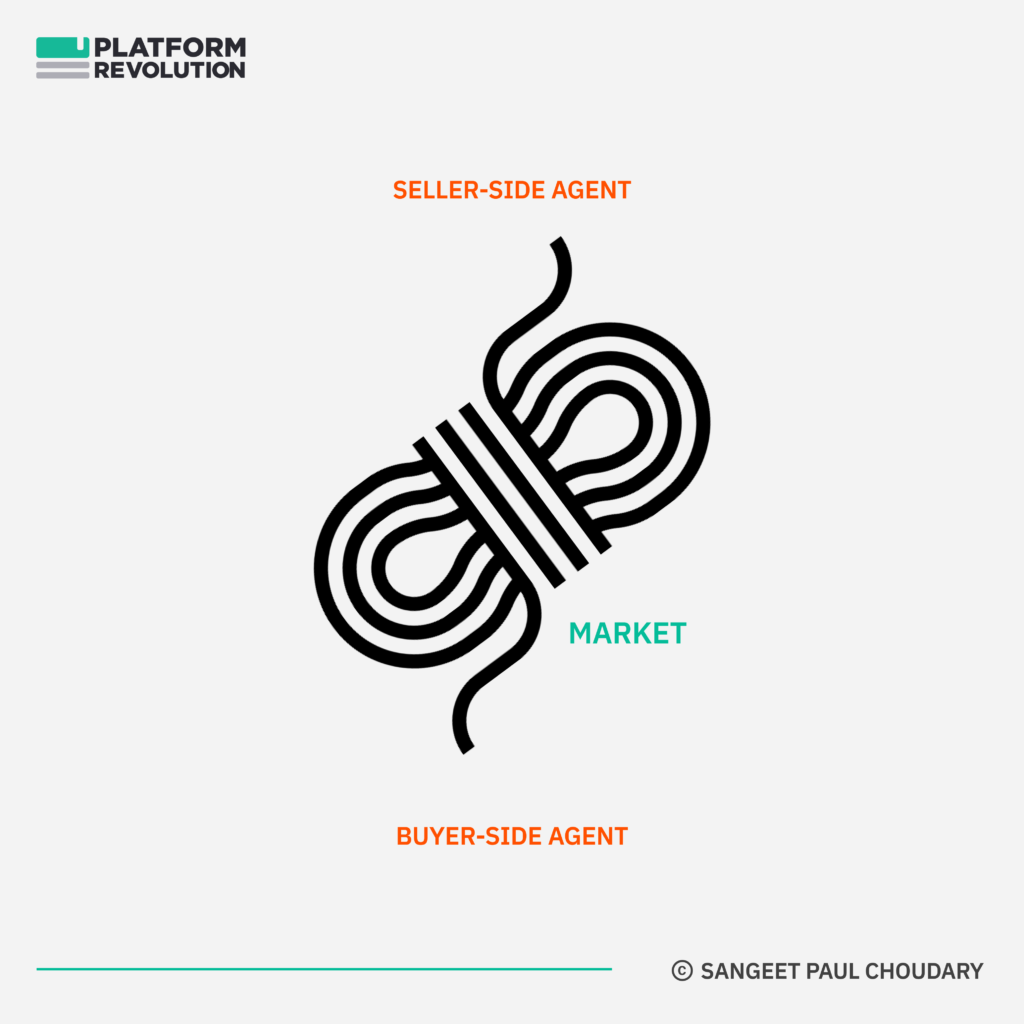
Platforms, in fact, bundle both a buyer-side agent and a seller-side agent.
Enter: The dual agent problem
This is the dual agent problem – a scenario where platforms/marketplaces bundle both the buy-side and the sell-side agent with the two-sided market mechanism, making it impossible to maximize outcomes for all market participants.
Uber’s dual agent problem:
Uber is a classic example of the dual agent problem. Uber acts as both the buyer’s agent for the rider and the seller’s agent for the driver, bundling these roles together along with the central market of available cars and people looking for those cars. It acts on behalf of buyers and on behalf of sellers – to the extent that in eliminates choice entirely. You no longer choose which driver comes to pick you. And drivers – penalized for high cancellation rates – have little choice over which riders they want to have on board.
Uber isn’t merely a market.
It’s a bundle of a market, a buyer’s agent, and a seller’s agent.
Amazon’s dual agent problem:
Amazon, similarly, combines a merchant-side agent, helping take products to market, with a consumer-side agent, helping find merchant inventory.
Bundling a buyer’s agent and a seller’s agent together – creates a dual agent with inherent conflicts of interest. It can never operate to maximize outcomes for both parties.
Operating dual agents in the online jobs market:
The components of this bundle are more clearly seen in the online jobs market. Most online job platforms have two business units. The first – called a marketplace – aggregates candidate listings. The second – typically an HR management Saas business – creates lock-in into the client, and acts as a client-side agent. Over time, the marketplace increasingly acts like a candidate-side agent, integrated with the HR management Saas business working as a client-side agent.
Here’s the dual agent conundrum: By being simultaneously an agent for both sides, a platform cannot solve for all parties involved. If anything, by acting as both the buyer-side agent AND the seller-side agent, it can maximise profits for its own self. Imagine a real estate market where buyer-side agents and seller-side agents fully coordinate with each other to maximize fees extracted both from buyers and sellers and selectively show listings to either side only if their higher fees are agreeable. The buyer and seller lose, the agents win.
This is also why it is so difficult to regulate platforms.
- It is easy to regulate buyer-side agents, whose success is aligned with buyer success or seller-side agents whose success is aligned with seller success.
- But it’s very difficult to regulate platforms, who can always demonstrate value to one side while side-stepping issues about exploitation of the other.
This is a false bundle. In financial markets or in real estate, markets and agents are distinct. Bundling them together works only in the platform’s favour and against the ecosystem.
False bundle #2: Bundling actor accreditation with market-making
The first bundle above may still yield market efficiency while compromising producer/consumer outcomes. The second bundle here goes a step further to create the conditions that prioritize platform extraction over market efficiency.
Platforms bundle the functions of accrediting buyers and sellers with providing market access to these parties. Consider Amazon, which manages listing certification while also managing market access. Or Airbnb, which manages host rating as well as managing the market of accommodation.
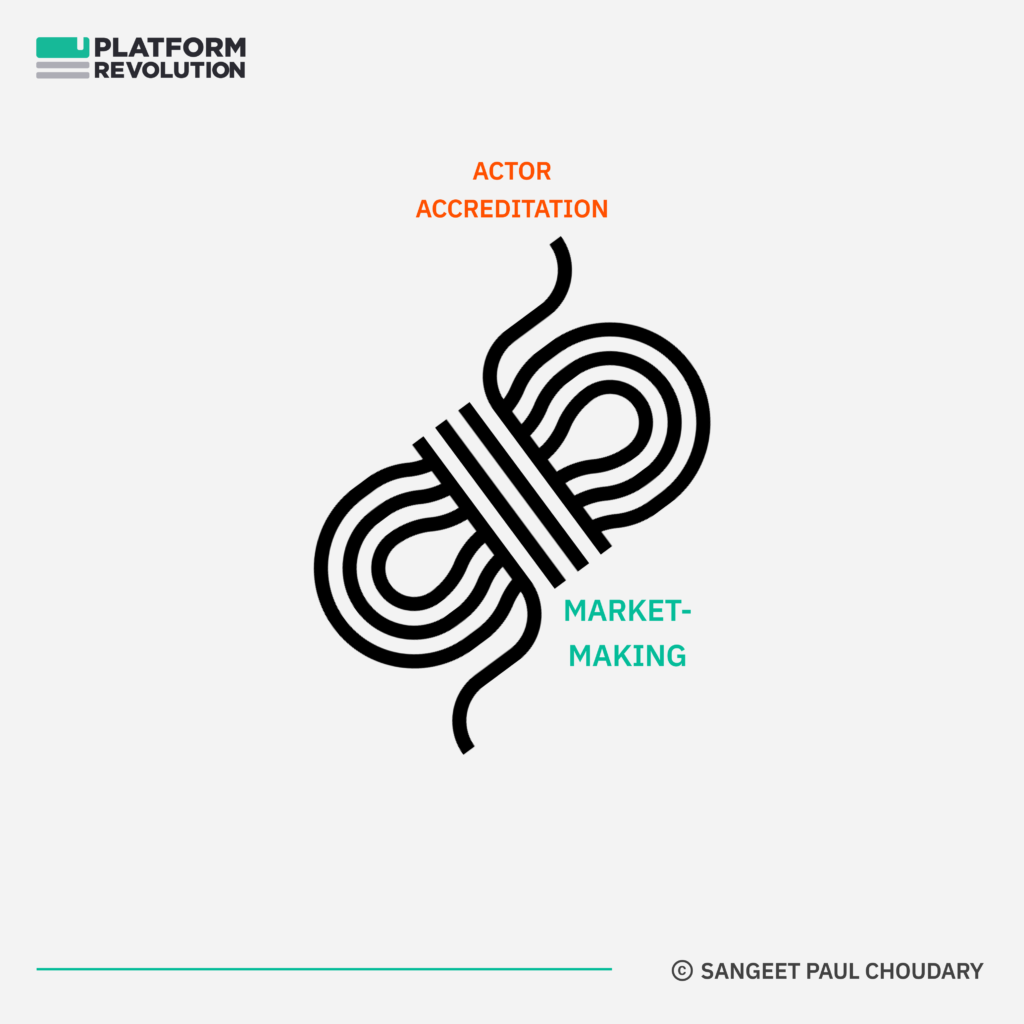
This bundling creates a false incentive where the platform can monetize access to accreditation and prioritize extraction from sellers over market efficiency.
Amazon’s perverse incentives
Consider Amazon that offers various forms of listing accreditation (e.g. ”Top Seller”) based on volume of sales. On the face of it, this sounds like the workings of an efficient market where the greater sales are rewarded with a “Top Seller” accreditation.
However, a combination of factors at play create an extraction engine out of this bundle.
First, Amazon encourages sellers to purchase its advertising services in order to drive more sales, often encouraging that doing so gets them to Top Seller status.
Second, till very recently, Amazon required sellers to purchase Fulfilment by Amazon in order to be eligible for Prime delivery, which in turn is critical to becoming a Top Seller.
Through a variety of such mechanisms, Amazon ensures that its market accreditation products combined with the market access incentives for sellers create new extraction engines for the platform.
In 2024, bundling actor accreditation with market access may not be seen as a false bundle. Aren’t platforms required to have reputation systems?
Unbundling reputation from market-making
Reputation systems are required in the platform economy but they don’t necessarily need to be bundled with the platform. They can exist as public data sources.
In fact, most financial markets unbundle the two to avoid precisely the above conflict of interest.
Consider, for instance, the securities markets, such as stock exchanges or bond markets. Market makers are typically brokerage firms or specialized trading firms that stand ready to buy or sell securities at publicly quoted prices. On the other hand, actor accreditation may be obtained through regulatory bodies, like the Securities and Exchange Commission (SEC) or the Financial Industry Regulatory Authority (FINRA), or through professional associations.
In the market for loans, actor accreditation is often performed through the use of credit scores, which serve as a standardized measure of an individual’s creditworthiness. In this market, lenders, such as banks, credit unions, provide the loan. Actor accreditation in the loan market is facilitated through credit scores, managed by credit reporting agencies, such as Equifax, Experian, and TransUnion.
As long as market making is bundled with actor accreditation, platforms will get away with false bundles, masquerading as efficient markets, while indirectly monetizing access to actor accreditation, as in the Amazon example above.
Bundling a buyer’s agent and a seller’s agent together - creates a dual agent with inherent conflicts of interest. It can never operate to maximize outcomes for both parties.
Feel Free to Share
Download
Our Insights Pack!
- Get more insights into how companies apply platform strategies
- Get early access to implementation criteria
- Get the latest on macro trends and practical frameworks
False bundle #3: Bundling data capture with recommendation systems
Here’s a third bundle that sits at the center of the privacy debate.
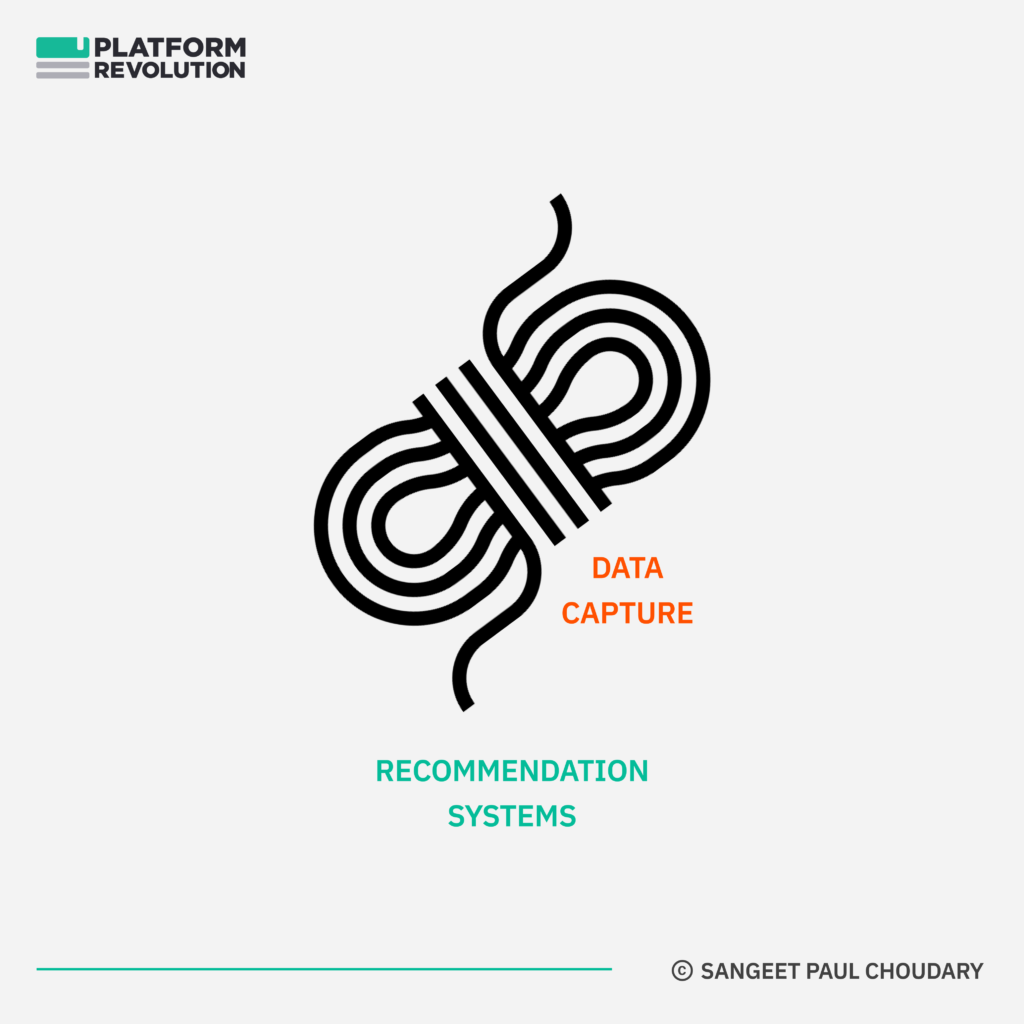
Platforms bundle control of user data with provisioning of recommendation systems, under the guise of delivering personalization.
This bundle creates the challenge of over-extraction, well documented in Shoshana Zuboff’s work on Surveillance Capitalism. Essentially, platforms capture excessive data beyond that needed to deliver personalization and market efficiency. By asking users to trade-in data for personalization, platforms gain a license to over-extract for their own purposes, very often compromising value and welfare for users.
This is a false bundle. Data can very well sit with the user and be opened out selectively for personalization, as and when the user desires. The technical architecture for user-owned-and-provisioned data already exists. The challenge, though, is that managing consent to data involves significant user overhead. Imagine a user having to constantly decide what data to open out to each and every website.
Unbundling with user-owned data and AI agents
This challenge may change as user-centric AI agents become more sophisticated and start making that decision on behalf of users. Personalization may be achieved through user-owned data systems (e.g. Solid Protocol) where multiple AI agents compete to gain right to mediate services to the user and provide the best recommendations without compromising user privacy.
As long as data capture and recommendation systems are bundled together, a perfectly competitive market of agents can’t exist and the platform-designated agent (i.e. the platform’s recommendation system) emerges as the default monopoly provider of recommendations.
False bundle #4: Bundling listing exclusivity with market access
Here’s the final bundle.
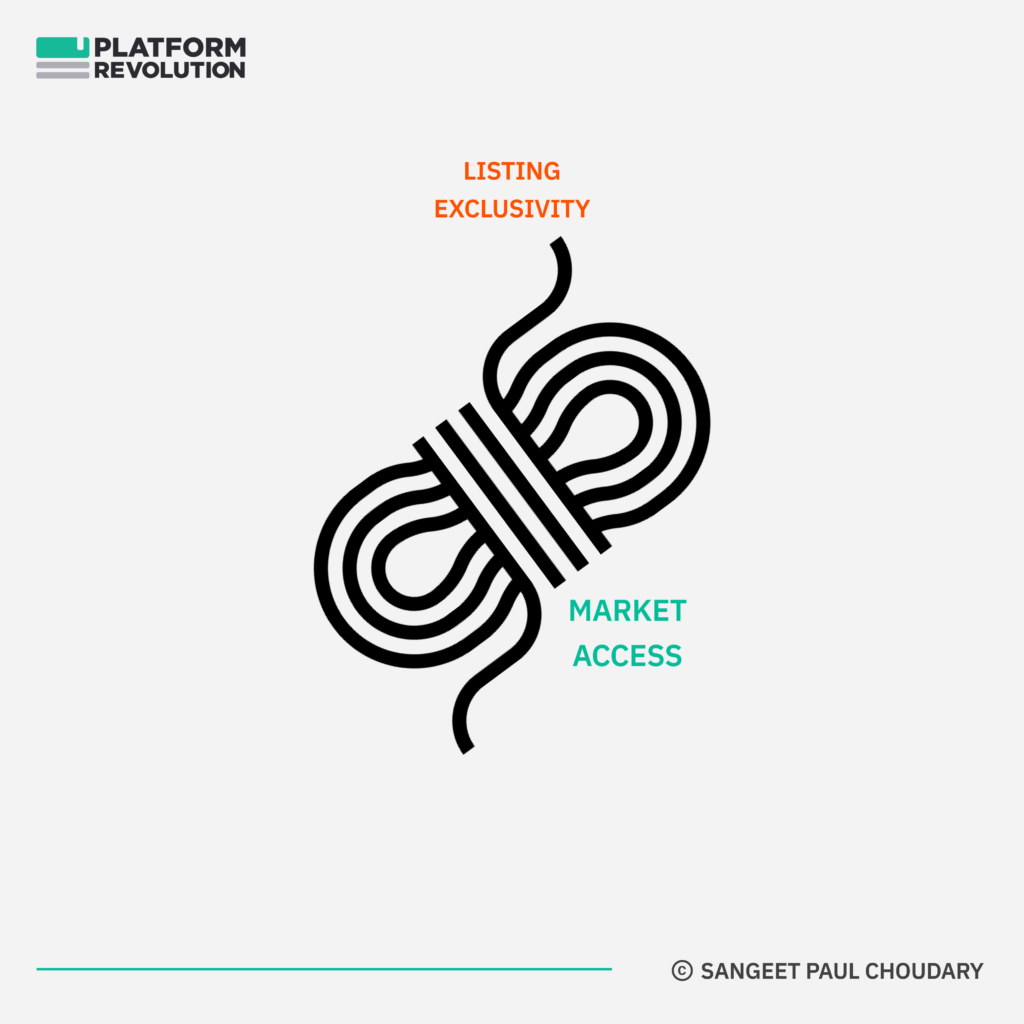
Platforms require producers to host their products exclusively on the platform in exchange for access to the platform’s market or customer base. Further, the larger the market access that the platform promises, the more effectively it can restrict producers from serving the same listings elsewhere.
Amazon’s false bundle
Consider, for instance, Amazon’s price matching algorithm which prevents sellers from hosting their products for a lower price elsewhere on the internet.
This is clearly restrictive for the seller but platforms often argue that it results in superior prices for consumers. Take Amazon’s example. The argument, thus far, has been that the marketplace can guarantee consumers the lowest available price, thanks to its price matching algorithm.
But here’s the rub. This short term best-price-guarantee leads to a long-term marketplace-driven price inflation through a series of steps:
- The price matching algorithm eliminates competition over time as rival platforms cannot offer better deals on the same product and eventually go out of business.
- Reducing competition enables the dominant marketplace – in this case, Amazon – to keep raising seller fees.
- Sellers, in turn, are stuck as they have no other option.
- An increase in seller fees now translates to higher prices for the consumers as the sellers pass on the fee hike to the consumer to maintain their margin.
- As sellers hike up their price on Amazon, they also need to increase their price everywhere else on the internet (including their own website) to stay compliant with the price-matching algorithm.
Ironically, this false bundle, and the negotiating power it grants the platform ends up making the market more inefficient over time.
The real business of platforms
Why are false bundles so central to the workings of the platform economy?
Platforms claim that they are in the business of creating efficient markets.
That’s not entirely true.
Platforms are really in the business of creating vehicles to privatise market mechanisms.
Today’s platforms prioritize wealth extraction and control over market efficiency.
Traditionally, markets leverage a range of market mechanisms to coordinate the actions of producers and consumers. These include, for instance,
- price mechanisms (signalling to convey information about supply and demand conditions),
- competition management (to encourage efficiency and innovation by allowing multiple buyers and sellers to participate freely),
- market clearing mechanisms (to drive market liquidity), and
- market regulation.
With platforms, these market mechanisms get increasingly privatized as they move from merely aggregating supply and demand to creating ‘full stack’ platforms and consolidate control over key market functions.
The four false bundles laid out above serve as vehicles for privatizing market making.
In the platform economy, a false bundle aims at bundling
a vector of market efficiency with
a vector of market control.
To the extent that creating market efficiency serves the platform’s goal of market control (i.e. sitting in the middle), platforms will provide market efficiency.
Reimagining the internet
This work is part of an ongoing stream of work I’ve been doing on thinking about alternate structures for the internet.
If you’ve enjoyed reading this article, you might also enjoy my work on The Building Blocks Thesis.
If you’re building in the realm of composable ecosystems, private data, protocol-based market-making, and agent-driven bundling, feel free to write in to sangeet@platformthinkinglabs.com. Let’s discuss!
State of the Platform Revolution
The State of the Platform Revolution report covers the key themes in the platform economy in the aftermath of the Covid-19 pandemic.
This annual report, based on Sangeet’s international best-selling book Platform Revolution, highlights the key themes shaping the future of value creation and power structures in the platform economy.
Themes covered in this report have been presented at multiple Fortune 500 board meetings, C-level conclaves, international summits, and policy roundtables.




Subscribe to Our Newsletter
