


Disruption
Assistance, augmentation, and automation
The rise of next-gen platforms
The scene stealers at CES 2017 were digital assistants powered by artificial intelligence. Amazon’s Alexa and Microsoft’s Cortana were joined by Baidu’s Little Fish, LG’s Hub Robot and Mattel’s Aristotle among a host of other virtual Jeeves.
Amazon which had been powering ahead all through 2016 with Alexa reportedly closed last year with 45,000 robots in its fulfilment centers. That was a 50 per cent increase in its robot headcount over a year before, signaling the rapid pace at which automation is moving at the e-commerce giant.
IBM Watson’s augmented intelligence has been quietly making inroads into hospitals and financial firms helping doctors and bankers make sense of data to arrive at diagnoses and spot opportunities and risks.
These developments foretell a significant shift towards the age of the tech-enhanced human: where machines work with humans, instead of against them. Tech enhancement should be seen through a framework of three ‘A’s — assistance, augmentation and automation — forces that have been quietly gaining momentum over the last couple of years and which are likely to go mainstream this year.
Assistance
Automated software applications that assist human users with search and retrieval related intelligence are getting better. And as their capabilities get enhanced, usage will spike. Research organization Tractica forecasts that there will be 1.8 billion consumer users of virtual assistants worldwide by 2021 and 843 million enterprise users.
But if you look at Google Assistant, Amazon’s Alexa, China’s LingLong Ding Dong, they work alongside our core capabilities — they complement our own skills easing our tasks.
Augmentation
Augmentation, on the other hand, enhances our core capabilities by providing specifically contextual support that is required to do a task. The way doctors are working with IBM Watson is a great example of augmentation. IBM Watson with its deep cognitive computing skills assimilates vast amounts of patient information and interprets them reducing time for doctors to make their diagnoses.
Similarly, DAQRI’s Smart Helmet can recognize machine parts, read gauges, and could change the way workers process information and get work done. Mitsubishi Electric is using smart glasses to provide air-conditioner service technicians with a three-dimensional overlay that shows them the components of the company’s most popular residential air conditioner.
Automation
The third A — automation — takes it a step further, removing the need for human effort. Automation is not complementary to human skills but is a substitute bringing in agility to tasks, a pre-requisite in today’s world. But automation need not necessarily always mean job losses, especially in areas where significant judgement calls are needed. A classic example is self-driving cars.
It’s fascinating to see the different approaches to tech enhancement that industries are taking
Feel Free to Share
Download
Download Our Insights Pack!
- Get more insights into how companies apply platform strategies
- Get early access to implementation criteria
- Get the latest on macro trends and practical frameworks
Productivity Gains
Tech enhancement will have significant economic impact for organizations, nations and individuals as the three As democratize productivity gains.
The last great example of democratized productivity gains was probably the washing machine which freed up women from household chores allowing more of them to enter the workforce. Similarly, the three As are going to lead to significant societal impact as technology will propel humans up the skills ladder.
As the three As gain traction, we may see a surplus of entrepreneurial productive capacity being created and economies that encourage these will accelerate faster. The labor cost advantage that emerging economies were banking on will slowly vanish. Already, we are at the fag end of the services arbitrage that the first phase of globalization enabled.
The big losers may well be economies such as India, Vietnam and Philippines that relied on this too much. China, very astutely, has shifted from a manufacturing export-driven economy to one satisfying internal consumer demand and is increasingly adopting the three As.
Industry Approaches
It’s fascinating to see the different approaches to tech enhancement that industries are taking. In retail, consumer decisions are becoming more assisted. Supply chains that bring products to us, on the other hand, are becoming more augmented.
In healthcare, again, at the patient end there is assistance in the form of chatbots and virtual platforms, while at the provider end there is augmentation (diagnosis) as well as automation (surgery).
Marketing will get more automated but high end selling — for example, investment products – will see more augmentation as humans team up with robot advisors.
In some jobs, we will see automation, while in others augmentation. The exact choice will be determined by the degree to which a job will rely on cognitive decision making versus data-driven models, and the degree to which all inputs can be digitized. Augmentation will not lead to job losses while automation might.
Next-Gen Platforms
In general, assistance will help consumers make better consumption decisions and navigate an increasingly smarter environment. Augmentation, wherever it comes in, will likely increase the labor pool, leading to a net positive effect on job creation as it will reduce the skills required to take on the work. A classic example of this is how GPS technology has allowed anyone to become a driver and led to platforms such as Uber. We are going to see similar examples in healthcare and financial services where augmentation creates new supply that can be leveraged on new platforms.
The next big operating system may well be the human body. With USB drives installed in finger tips, surgically modelled third ears that are Wi-Fi enabled, body hackers are already attempting to create an alternate anatomy.
But, for now, augmentation and assistance is where I’ll be looking for future platform opportunities as a new class of producers gets unlocked.


State of the Platform Revolution
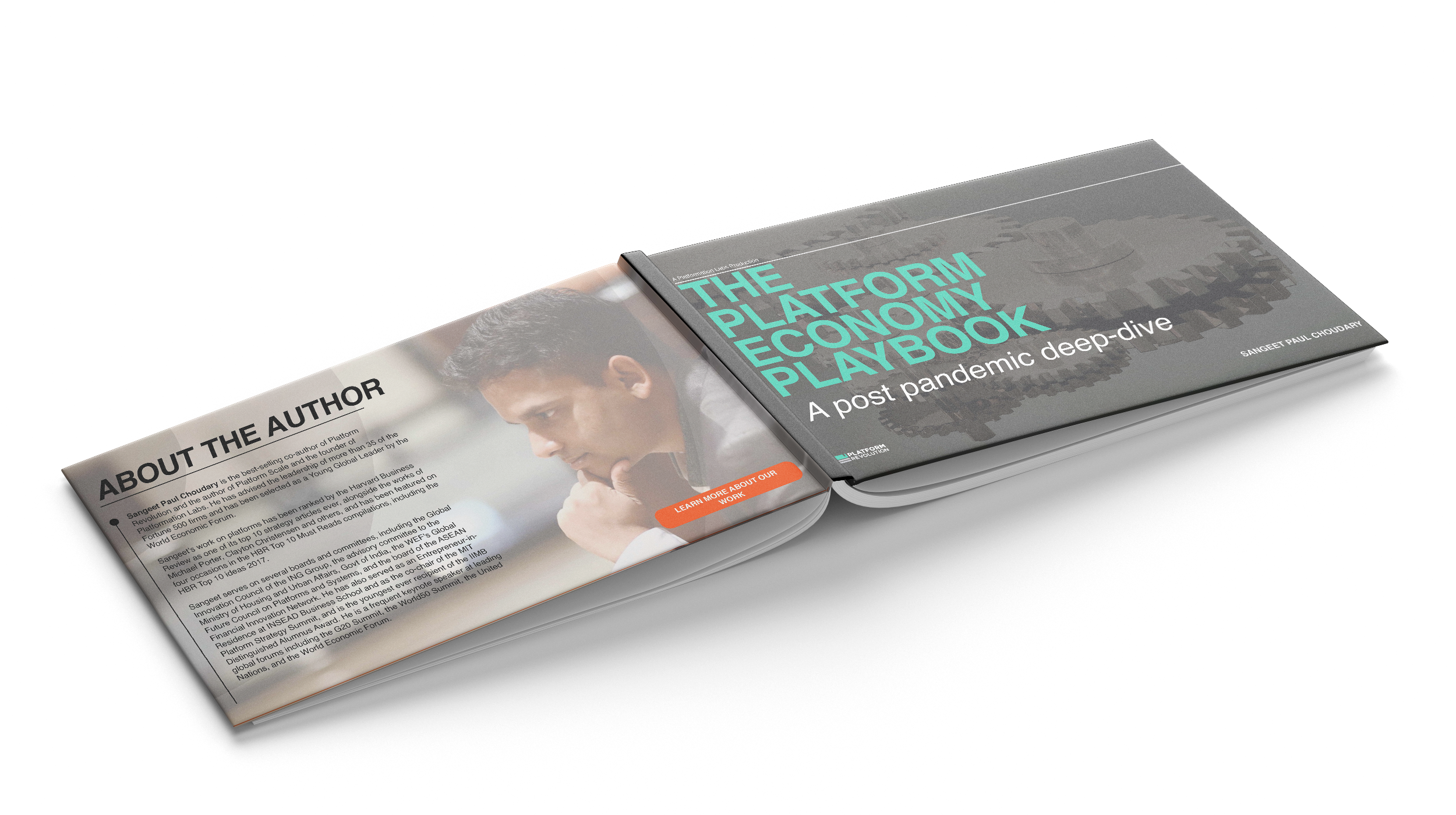
The State of the Platform Revolution report covers the key themes in the platform economy in the aftermath of the Covid-19 pandemic.
This annual report, based on Sangeet’s international best-selling book Platform Revolution, highlights the key themes shaping the future of value creation and power structures in the platform economy.
Themes covered in this report have been presented at multiple Fortune 500 board meetings, C-level conclaves, international summits, and policy roundtables.

Subscribe to Our Newsletter
